
A garage door opener that is starting to fail rarely gives out all at once. In our experience working with homeowners across Twinsburg, OH and the surrounding communities, the signs show up weeks or even months before the unit stops working completely. Slow response times, grinding sounds, intermittent operation, and safety sensor failures are among the most telling indicators that something is wrong inside the system. Catching these signs early is the difference between a straightforward repair and a full replacement that could have been avoided.
This guide walks through the top signs your garage opener needs professional attention, what each one means mechanically, and when it is time to stop troubleshooting and make the call.
Why Catching Opener Problems Early Matters
Most residential garage door openers are rated for between 10,000 and 15,000 operating cycles. For a household that uses the door four times a day, that translates to roughly 7 to 10 years of normal use before internal components begin to show meaningful wear.
What we see in the field tells a more complicated story. In northeast Ohio, the freeze-thaw cycles through January and February put extra strain on every moving part of the door system. When temperatures drop overnight and the door sits closed against a frozen threshold, the opener works against resistance it was never designed to handle regularly. That strain shortens the lifespan of the motor, drive components, and logic board faster than the manufacturer’s cycle rating accounts for.
Homeowners who pay attention to small changes in how the opener sounds and moves catch problems at the repair stage. Those who wait until the door stops working entirely often face a more extensive failure that has spread to the springs, cables, or tracks.
Grinding, Rattling, or Humming Sounds During Operation
Sound is one of the most useful diagnostic tools on a service call, and each type of noise points to a different part of the system. Grinding almost always means worn gears inside the motor housing. On older openers, particularly chain-drive and belt-drive units running a heavy two-car door for a decade or more, the plastic drive gear is typically the first component to fail. By the time the grinding becomes noticeable, the gear teeth are usually stripped on one side and the motor is carrying the full mechanical load on its own.
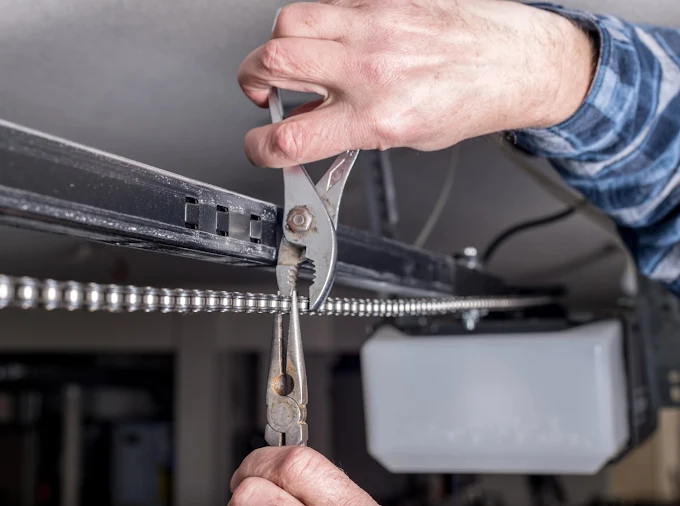
Rattling points to a stretched chain or loose hardware along the rail. A chain stretched beyond its adjustment range will skip under load, creating uneven movement that stresses the trolley and door brackets over time.
Humming without door movement usually means the motor is receiving power but cannot turn the drive shaft. A failed starting capacitor is the most common cause. Capacitors store an electrical charge even when the unit is unplugged and can discharge unexpectedly, making this a professional-only repair.
The Opener Responds Slowly or Not at All
A delay between pressing the remote and seeing the door move is one of the earliest signs of opener trouble. Check the basics first. Dead batteries and signal interference from new LED bulbs or smart home devices are common causes unrelated to the opener itself. If the wall panel responds but the remote does not, the issue is with the remote or antenna. If neither responds consistently, the problem is inside the unit.
In our experience, intermittent response that starts gradually and worsens over weeks usually points to a failing logic board. The logic board is the brain of the opener, and when it degrades, signal processing becomes unreliable before it stops entirely. This is a professional-only repair requiring the right diagnostic tools to confirm and address correctly.
The Door Moves Unevenly or Stops Midway
A door that hesitates, jerks during travel, or reverses before completing a full cycle means the opener is working harder than it should. What we find more often is that the door has gone out of balance and the opener is straining to compensate.
A properly balanced door stays in place at the midpoint when disconnected from the opener and lifted manually. If it drops or shoots upward, spring tension is off and the opener motor is absorbing that imbalance on every cycle. We have seen openers fail years ahead of their expected lifespan simply because they were running against a door never properly balanced after a spring replacement.
A technician needs to check both door balance and opener force settings together. Adjusting force settings without addressing door balance is a temporary fix that does not solve the root problem.
The Safety Sensors Keep Triggering Without a Clear Obstruction
Every modern garage door opener has two photo-eye sensors mounted near the floor on each side of the door frame. When they keep triggering without an obvious obstruction, the cause is usually simpler than a faulty sensor.
In the late summer and early fall in northeast Ohio, spider webs and fine dust accumulate on sensor lenses faster than most homeowners expect. A door that suddenly refuses to close in September often traces back to a lens not wiped since spring. A clean dry cloth on both lenses takes thirty seconds and solves the problem more often than not.
Sunlight angle is another factor. During certain times of day in late autumn and winter, direct sunlight can overwhelm the infrared signal on the receiving sensor. If the issue only happens at the same time each day, sun interference is likely the cause. If cleaning and alignment do not resolve it, sensor wiring replacement is a professional-only task.
The Opener Runs but the Door Does Not Move
When the motor runs and the trolley moves but the door stays still, check the manual release first. Every opener has a red emergency release cord that disconnects the trolley from the door. If pulled accidentally, the opener runs freely without engaging the door. Reconnecting it requires no tools.
If the trolley is engaged but the door still will not move, the problem is mechanical. Stripped drive gears are the most common cause on older units. A broken drive belt or snapped chain produces the same result. Both require opening the motor housing and replacing internal components, making them professional-only repairs.
The Wall Panel or Remote Works Intermittently
Controls that work sometimes and not others are frustrating because the problem is hard to reproduce on demand. In our experience, intermittent failures not caused by dead batteries or interference usually point to a failing logic board or loose wire connection inside the unit.
In northeast Ohio, temperature swings between summer and winter cause wiring connections inside the motor housing to expand and contract over the years. Eventually those connections loosen at the terminal, creating intermittent failures that are difficult to catch unless you know where to look. Intermittent failures almost always escalate. Getting a technician involved early is far less disruptive than waiting for a complete failure.
The Opener Is More Than 10 Years Old
Age changes every repair decision. An opener that is 12 years old and showing multiple symptoms is likely approaching the end of its serviceable life. Every repair at that point needs to weigh fixing the current problem against the probability of another component failing within the year.
Modern openers offer battery backup, rolling code security that changes the access code after every use, and smartphone connectivity. A technician can give you an honest comparison between repair and replacement based on the actual condition of your unit, not a sales pitch.
When to Stop Troubleshooting and Call a Professional
A homeowner can safely replace remote batteries, wipe sensor lenses, check sensor alignment, and reconnect a disengaged manual release. Beyond that, the components involved in garage opener repair carry real risks.
Springs and cables operate under extreme tension. If the opener is failing because the door has gone out of balance due to a spring problem, operating the system manually without addressing the spring first is dangerous and puts everyone nearby at risk. At GSD Garage & Gates, every service call starts with a full 21-point safety inspection covering the springs, cables, drums, hinges, rollers, tracks, opener performance, and overall door condition. We are not just fixing the symptom. We are checking the whole system to make sure nothing else is close to failing.
Get Garage Opener Repair From GSD Garage & Gates
If your opener is showing any of the signs in this guide, have it looked at before the problem grows. GSD Garage & Gates is a locally owned, family-operated company serving homeowners in Twinsburg, OH and surrounding communities including Chagrin Falls, Pepper Pike, Beachwood, Gates Mills, and Moreland Hills with honest, no-pressure service.
We often provide same-day service and can have a technician at your home within a few hours. Every visit includes our full 21-point safety inspection at no extra charge. Reach out to GSD Garage & Gates today. Our team is available seven days a week and will give you a straight answer about what your system needs before any work begins.