
Most homeowners find out their garage door spring needs replacing at the worst possible moment: the door will not open, the car is inside, and there is somewhere to be. The spring did not fail without warning. It gave signs for weeks, sometimes months, before the final break. Those signs went unnoticed because most people do not know what to look for or when a spring is in its replacement window.
In our experience serving homeowners across Twinsburg, OH and the surrounding communities, the calls we prefer most are the scheduled ones. The homeowner noticed something, called before the spring failed, and we replaced it as a planned service visit. The calls we see most often are the emergency ones, where the spring snapped and the door is stuck. Both start from the same spring. One just gets acted on sooner.
How a Torsion Spring Works Under Daily Load
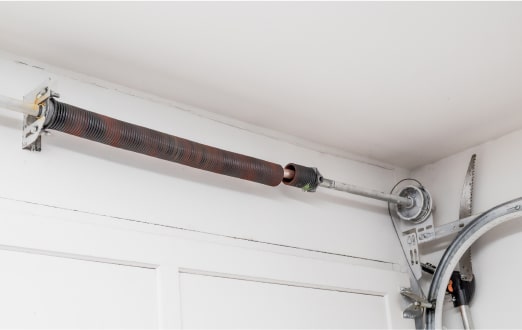
A torsion spring mounts horizontally on a steel shaft above the garage door opening. Every time the door closes, the spring winds and stores mechanical energy. Every time the door opens, that stored energy unwinds and offsets the door weight, so the opener guides movement rather than hauling the full load. A standard two-car steel door can weigh more than 200 pounds. Without the spring doing its job, the opener carries that entire weight unassisted.
Spring lifespan is measured in cycles, not years. One cycle is one full open plus one full close. Standard residential torsion springs are rated for approximately 10,000 cycles. At four cycles per day, a common use rate for a home where the garage is the primary entry point, that rating is consumed in roughly six to seven years. At two cycles per day, the same spring can last twelve or more. The calendar number is less useful than the use pattern.
The spring does not wear uniformly from day one to failure. Metal fatigue concentrates at points of highest stress: the winding cone where the spring attaches to the shaft, and the center coil where tension is greatest during the lift cycle. A spring in the early stages of fatigue continues to function. A spring approaching failure begins to signal it.
The Warning Signs That Appear Before a Spring Fails
The door moves unevenly or jerks mid-travel. One side of a two-spring system can lose tension ahead of the other, causing the door to rack slightly out of square as it moves. In our experience, this is most noticeable in late fall and early winter in northeast Ohio, when thickening lubricant and contracting metal make an already-fatigued spring work harder than it should.
The door feels heavier than normal when lifted manually. Disconnect the opener, lift the door to waist height, and let go. A properly balanced door holds position. A door that drops is not being fully counterbalanced by the spring. The opener has been compensating for that loss on every automated cycle, adding strain to the motor and drive system.
Visible gaps appear in the coil. A healthy torsion spring is a continuous, tightly wound coil with no space between the wraps. A spring that has partially failed develops a visible separation where the metal has stretched beyond its elastic limit. That gap is the clearest sign that replacement is no longer a question of timing.
The spring produces new noise during operation. A spring nearing the end of its service life generates friction at the winding cone and center collar that a healthy spring does not. In northeast Ohio, humidity from Lake Erie weather patterns accelerates surface oxidation on the coil, which binds the metal and produces a grinding or squealing sound homeowners sometimes attribute to the opener. If lubrication does not resolve the noise within a day or two, the spring is the more likely source.
Why the Northeast Ohio Climate Shortens Spring Lifespan
Torsion springs are made from high-carbon steel, which is sensitive to thermal cycling. Northeast Ohio experiences temperature swings that can exceed 80 degrees Fahrenheit between seasonal extremes. Garages in the region are not climate-controlled, which means the spring is exposed to the full range without insulation buffering the shift.
Each time the steel contracts in cold and expands in heat, it undergoes stress at the coil level that compounds alongside normal cycle fatigue. A spring at 8,000 cycles in a northeast Ohio garage has endured a different set of conditions than one at 8,000 cycles in a mild climate. Lake Erie weather also brings sustained humidity that accelerates surface oxidation on the coil. Corroded metal is less elastic and more brittle, which means a spring in this region can reach failure before its cycle count suggests it should.
Homeowners in Twinsburg, Chagrin Falls, and Beachwood who use the garage as a primary entry point are putting both cycle load and environmental stress on the spring at the same time. Both factors need to be part of how replacement timing is assessed.
Why Proactive Replacement Costs Less Than Emergency Replacement
A planned spring replacement is a single-line service call: the technician arrives, removes the worn spring, installs a new one matched to the door weight and track configuration, and tests the system. The cost reflects parts and labor for one repair.
An emergency replacement after a sudden failure involves the same parts and labor plus a compounding assessment. When a spring snaps under opener load, the motor has often absorbed significant overload before the thermal protection cuts power. If the door dropped or ran unbalanced, the cable may have jumped the drum and the roller brackets may be showing stress from carrying load unevenly. What starts as a spring call frequently becomes a spring, cable, and opener inspection all at once.
On proactive calls, we often find the cable drum and rollers showing early wear alongside the spring. Catching all three at one visit means one trip, one clear conversation, and one decision made without urgency. On emergency calls, the homeowner is making a stressed decision with a stuck door and a hard deadline.
What the Replacement Process Looks Like on the Day of Service
Before any new spring is installed, the remaining tension in the failing spring must be fully released. This is the step where most DIY injuries occur. A torsion spring under load stores significant mechanical energy, and releasing it without the correct winding bars and shaft control can cause the spring to unwind violently. Professional service eliminates that risk.
The replacement spring is selected to match the door: its weight, track configuration, drum diameter, and lift height. A spring incorrectly sized for the door’s actual load will fail sooner or cause the door to travel out of balance, creating secondary stress on the opener, cables, and hardware. After installation, the door is tested for balance manually before the opener is reconnected.
At GSD Garage & Gates, every spring replacement concludes with a full 21-point safety inspection covering the springs, cables, drums, hinges, rollers, tracks, opener performance, and overall door condition. If anything else is showing early wear alongside the spring, the homeowner knows before leaving the driveway.
When to Call for a Spring Inspection Even if Nothing Feels Wrong
A spring does not have to be producing visible symptoms to be in its replacement window. Homeowners at or past the seven-year mark, who use the garage as their primary entry, or who have an uninsulated garage in northeast Ohio are in the zone where a professional assessment makes practical sense. A household running four cycles per day in Twinsburg reaches 10,000 cycles in six to seven years. The spring may hold longer. It may not.
A spring inspection produces useful information: how much life is reasonably left, whether the cable and drum are showing synchronized wear, and whether the spring is still matched to the door current weight, particularly if panels have been replaced or insulation added since the original installation.
The right time for garage door spring replacement is not after the spring fails. It is before, when the decision is calm, the timing is chosen, and the cost is one repair.
Schedule Garage Door Spring Replacement With GSD Garage & Gates
If your garage door is showing any of the warning signs above, or if it has been seven or more years since the spring was last replaced, contact GSD Garage & Gates now. GSD Garage & Gates is a locally owned, family-operated company with 15 years of industry experience serving homeowners in Twinsburg, OH and surrounding communities including Chagrin Falls, Pepper Pike, Beachwood, Gates Mills, and Moreland Hills.
We often provide same-day service and can have a technician at your home within two to three hours. Emergency calls are handled and our team is available seven days a week. Every visit includes our full 21-point safety inspection at no extra charge. Reach out to GSD Garage & Gates today before the spring decides the timing for you.